
When most people land a new DevRel role, their immediate instinct is to start shipping things to prove their value. They build the Discord, write the guides, and book the speaking gigs because rapid output feels safe and measurable.
However, executing a generic playbook without aligning it to specific commercial bottlenecks means your hard work ends up deeply misaligned with what the company actually needs to grow.
Companies do not hire developer advocates simply to produce blog posts, conference talks, workshops, or community programs. They hire them to help solve specific business challenges through those activities. Sometimes, leadership teams are not even aware of their own underlying commercial bottlenecks, which gives you a massive opportunity to step in, diagnose the real issue, and stand out as an indispensable strategic asset.
Running your programs in isolation without being guided by these foundational challenges means you risk burning energy on initiatives that look impressive on paper but fail to actually help the business in any way that matters.
That structural disconnect is exactly how developer relations gets sidelined as a feel-good department. To protect your impact, your technical output must hook directly into the specific corporate challenges you were brought in to resolve.
So, how do you uncover the best way to contribute to the business in a way that helps them grow significantly, before you ever start producing? Usually, you analyze six distinct dimensions to gather this complete picture, namely:
- The company’s position in the market in order to map out exactly how developers already perceive your brand relative to your competitors so you can match your messaging and tone to their existing expectations.
- The company’s current growth stage in order to evaluate the internal maturity of the organization so you can target the exact funnel bottleneck holding back adoption.
- The company’s business model and monetization strategy in order to map out how the organization generates revenue so you can design advocacy initiatives that deliver clear commercial value.
- The product category and its competitive landscape in order to isolate unique technical advantages and friction points so you can position your tool as a superior choice.
- The buyers and implementers involved in product adoption in order to identify their distinct personas and practical jobs to be done so you can build highly relevant resources that solve their precise workspace frustrations.
- The surrounding internal teams in order to align with the core priorities and metrics driving neighboring departments so you can turn developer relations into an indispensable bridge for the entire business.
Figuring out the answer to all these questions helps you determine exactly what commercial bottleneck your technical execution needs to solve. And when you find that answer, everything changes. Suddenly you gain clear direction, stop wasting time on low-impact activities, and find it easy to explain how your work supports business outcomes. Best of all, cross-team collaboration becomes effortless because you are finally solving the exact same problems everyone else is chasing.
My book, A Friendly Guide to Developer Advocacy, discusses the full spectrum of drawing up a comprehensive strategy through diagnosing all of those points. This article focuses on just the first dimension, which is mapping out your company’s market position.
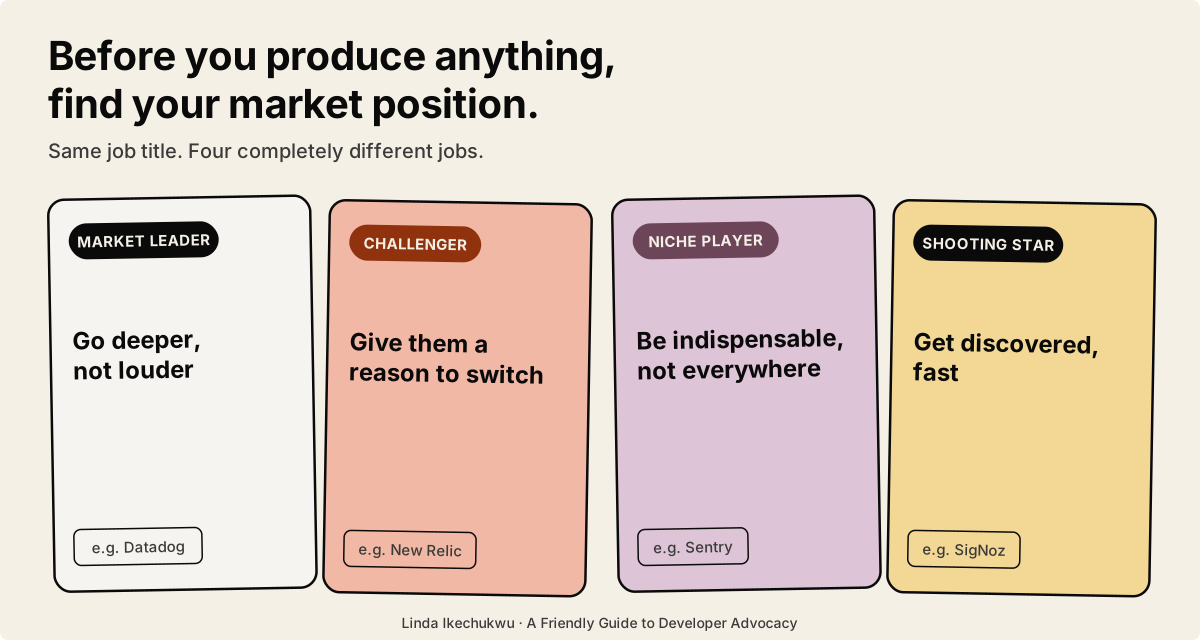
Most products fall into one of four distinct categories, and each one requires a completely different approach to developer advocacy. Here is what each one looks like.
The Market Leader
Market leaders already dominate their space and are no longer trying to prove themselves. They focus on scaling sustainably, deepening trust, and maintaining their leadership position. Think Datadog in observability, or Salesforce in the low-code enterprise space.
To pinpoint exactly where a dominant company needs your help, you must look through the lens of the AAARRRP funnel framework developed by Phil Leggetter. This model maps the developer lifecycle across seven distinct stages, spanning awareness, acquisition, activation, retention, revenue, referral, and product feedback. In another upcoming article, I discuss this funnel in depth.
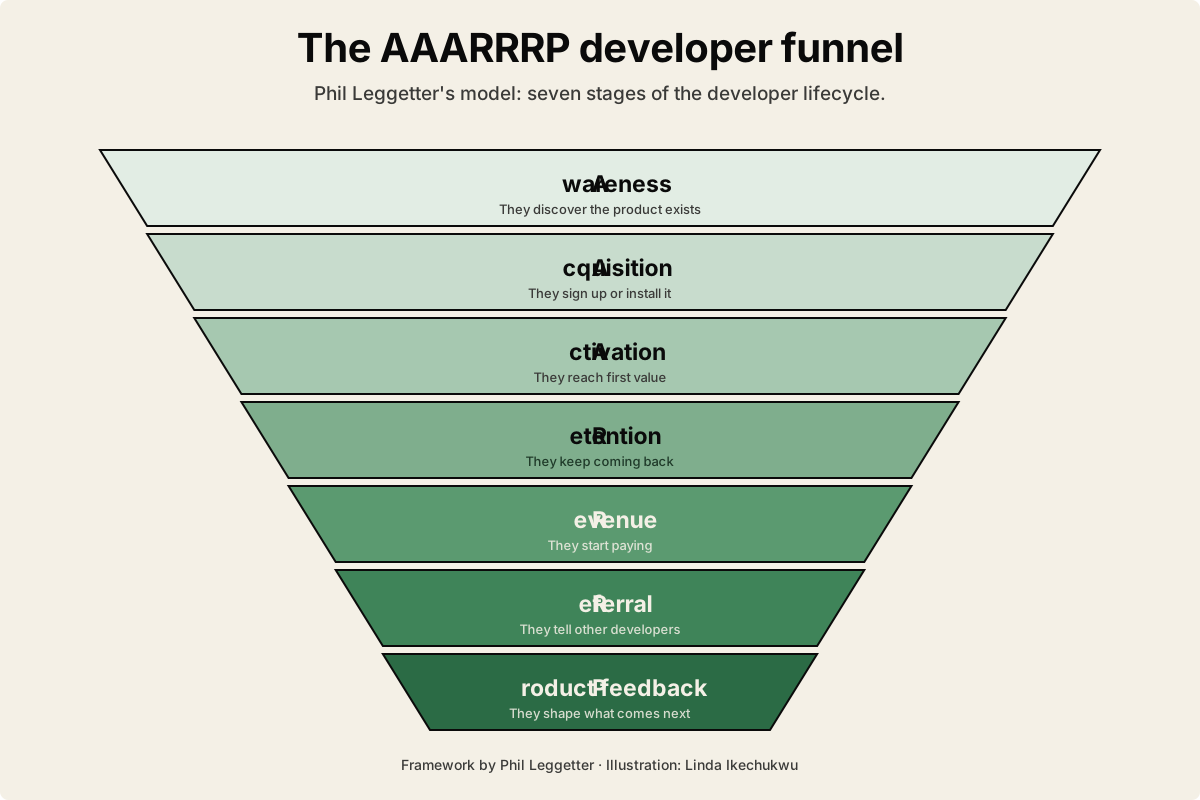
When you apply this diagnostic tool to a market leader, you quickly realize that top-of-funnel awareness is rarely the biggest constraint because they are already the default choice developers think of first.
The framework reveals that the real bottleneck sits much further down the funnel. Your true leverage lies in helping developers who already discover or try the product become successful with it, deepen their usage over time, and ultimately turn into advocates themselves.
Imagine you join Datadog as a developer advocate. Spending your first six months writing introductory content about why observability matters will not create much business impact. Most developers evaluating Datadog already understand why the category is important.
A better investment would be advanced technical content that helps users adopt new features, migration guides that reduce friction, or workshops that help existing customers extract more value from the platform.
The Challenger
Challenger companies are ambitious organizations that go head to head with established market leaders. They typically differentiate themselves through competitive pricing, a more modern developer experience, or a highly focused feature set. Think New Relic in the observability space, or Retool in the low-code landscape, both of which have had to earn developer trust in markets with deep-rooted incumbents.
To navigate this hyper-competitive landscape, you look to the AAARRRP framework to locate where the customer journey is stalling. For a challenger, the diagnostic funnel may reveal bottlenecks at the Awareness and Acquisition stages.
Unlike market leaders, challengers can assume developers already understand why the overall product category matters, meaning your strategic goal is purely to convince them that your tool is the superior option. This specific funnel bottleneck requires technical content that helps developers compare alternatives, unpack unique differentiators, and build enough confidence to make a complete ecosystem switch.
You will spend your time identifying specific friction points in dominant tools, positioning your product as the modern alternative, and creating migration guides that ensure a smooth transition. Your messaging needs to speak directly to existing developer disillusionment by proving exactly how your tool resolves the persistent problems of the old way.
The Niche Player
Some companies choose to solve highly specific problems for a tightly defined group rather than trying to serve the entire market. Think Sentry in observability, which carved out a deeply focused position around error monitoring and application performance for engineering teams. In the low-code space, Budibase executes a similar play by remaining open source and building specifically for developers who create internal utilities.
When you run this specialized company profile through the AAARRRP lifecycle framework, the operational goals shift dramatically. Niche players will likely prioritize absolute relevance over raw scale, meaning your developer advocacy strategy must mirror that exact precision.
The diagnostic kick here is realizing that Activation and Retention tend to happen much more naturally for a niche player, provided you can first capture highly targeted Awareness and Acquisition within your specific ecosystem layer.
A common mistake niche companies make is trying to mimic market leaders by broadening their messaging, chasing every passing industry trend, and slowly losing the sharp specificity that made developers care in the first place.
Rather than diluting your focus, your role requires you to become indispensable to the exact developers your company was built to serve. This means speaking their precise language, understanding their unique workflows, and creating deep technical content that feels like it could only have been authored by a seasoned industry insider.
The Shooting Star
Shooting stars are early-stage or fast-growing companies that gain traction by offering a fresh take or targeting an underserved market segment. Think SigNoz in observability, an open-source alternative gaining ground by targeting developers who want full control over their tracing stack without enterprise pricing. Or, Glide in the low-code space, growing rapidly and carving out its own place in mobile app creation directly from spreadsheets.
When a company operates as a shooting star, the AAARRRP funnel framework highlights a stark commercial reality. The primary hurdle for early-stage companies is building raw, top-of-funnel momentum alongside a rapid Product Feedback loop. They urgently need more developers to discover the product, test it, talk about it, and share honest feedback so the business can survive and find true product-market fit. Without that initial momentum, it becomes incredibly difficult to attract customers, code contributors, corporate partners, and venture investors.
This commercial urgency completely shapes your day-to-day work as an advocate. You will spend your energy seeding early communities, generating baseline awareness, gathering rapid product feedback, smoothing over onboarding friction, and directly helping shape the product itself.
At this stage, velocity and progress matter much more than rigid specialization, forcing you to wear several hats at once by acting as a writer, speaker, support representative, community manager, and product tester all in the same week. If you treat a shooting star like an established market leader and spend six months building polished community infrastructure before enough developers even know the product exists, you will burn valuable energy without ever solving the company’s biggest commercial limitation.
Turning Your Diagnosis Into a Plan
The uncomfortable truth about a DevRel career is that it never looks the same at two companies, and it should not. A market leader does not need the same strategy as a challenger, and a niche player should never behave like a shooting star. The work must change because the business context is different.
| Market position | Example | The developer’s view | Where the funnel usually stalls | What your advocacy should focus on |
|---|---|---|---|---|
| Market Leader | Datadog | Already the default, trusted choice | Deep funnel: retention, revenue, referral | Advanced content, feature adoption, and migration guides that help existing users extract more value. Go deeper, not louder. |
| Challenger | New Relic | A credible, more modern alternative | Awareness and acquisition | Comparisons, clear differentiators, and migration guides that give developers a reason to switch. |
| Niche Player | Sentry | The specialist for one specific problem | Awareness and acquisition within the niche | Deep, insider technical content for a precise audience. Be indispensable, not everywhere. |
| Shooting Star | SigNoz | The fresh, underdog option | Top of funnel: awareness and product feedback | Seed early communities, generate awareness, gather feedback, and help shape the product. Get discovered, fast. |
How each market position changes where the funnel tends to stall, and what your developer advocacy should focus on in response.
It is also important to keep in mind that this framework applies to individual products just as much as entire companies. A massive market leader might launch a brand-new product that enters the market as a challenger. In that scenario, your strategy should be shaped entirely by the market position of the specific product you are advocating for, rather than the parent company operating behind it.
However, understanding your market position is only the first step. It diagnoses the commercial challenge and points you toward the broad lifecycle outcomes that matter most, whether that means prioritizing awareness, activation, or retention. It does not automatically dictate your immediate task list.
Imagine two challenger companies competing against the same established incumbent. Both need developers to switch to their alternative, and on the surface, it might seem like they should run the exact same playbook. Now imagine that one of those companies is a Series A startup while the other is a Series D enterprise.
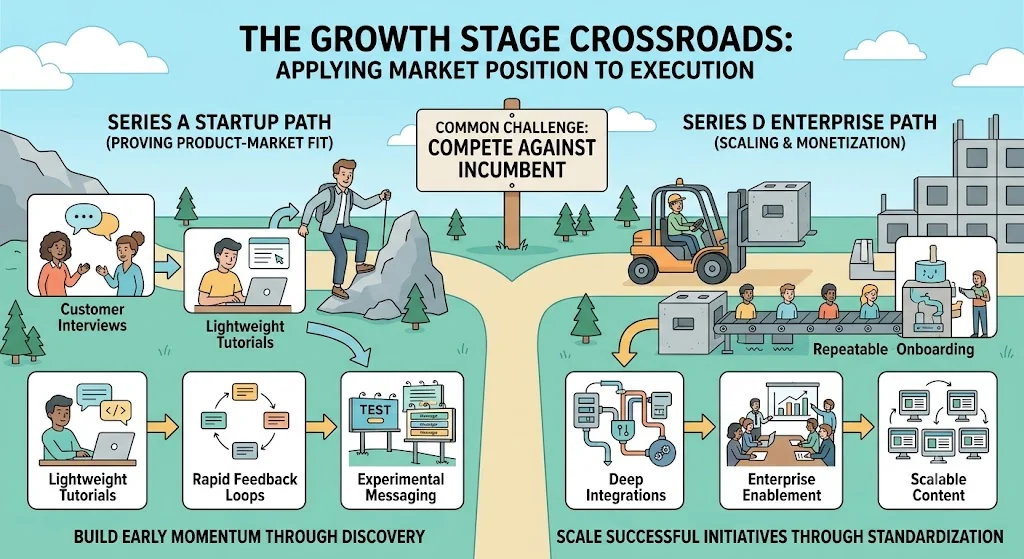
The Series A company is still actively proving product-market fit and learning what resonates with developers. Developer advocacy in this environment will focus heavily on customer interviews, lightweight tutorials, rapid feedback loops, and experimental messaging to build early momentum.
The Series D company is solving an entirely different scaling challenge. Armed with more resources and a larger customer base, their advocacy shifts toward repeatable onboarding, deep integration guides, enterprise enablement, and content that scales what they already know works.
They are both challengers trying to convince developers to switch, but they will execute entirely different strategies because they are at completely different stages of growth. Ultimately, your market position tells you what problem developer advocacy exists to solve, while your company’s growth stage tells you exactly how that problem should be solved today.
In the next article, we will look at exactly how a company’s growth stage shapes the developer advocacy initiatives you should prioritize, helping you decide where to invest your time for the greatest impact.
At the end of the day, your job is to help developers succeed in a way that directly drives the success of your company.